Persistent joint pain in Bathgate can make everyday activities increasingly difficult. Walking, exercising, working, climbing stairs or simply getting comfortable can become frustrating when pain and stiffness don’t seem to settle.
But is massage appropriate for joint pain?
The answer isn’t always simply yes or no.
At Leading Edge Therapies, we don’t believe that someone with ongoing pain should automatically be placed on a massage table and given a standard massage. The first step is understanding what may be contributing to your symptoms.
Our approach combines clinical knowledge, orthopaedic assessment and hands-on treatment to determine whether orthopaedic massage, sports massage or another approach may be appropriate.
When Is It Time to Get Your Pain Assessed?
You don’t have to wait until joint or muscle pain becomes severe before getting it assessed. If pain has continued for several weeks, keeps returning, or is beginning to affect the way you move, exercise, work or play sport, an assessment can help identify what may be contributing to the problem.
At Leading Edge Therapies, we see people with a wide range of ongoing musculoskeletal problems, including back pain, neck pain, shoulder pain, hip pain, knee pain, joint stiffness and muscular problems.
You may benefit from an assessment if:
- Your pain has continued despite rest or changing your activities.
- You are finding certain movements increasingly difficult.
- Pain is affecting your exercise, training or sport.
- You have reduced your normal activities because of discomfort.
- The same problem keeps coming back.
- You have stiffness or restricted movement in a joint.
- You have tried massage or other self-management approaches but the problem keeps returning.
- You are unsure whether your problem is muscular, joint-related or something that needs further investigation.
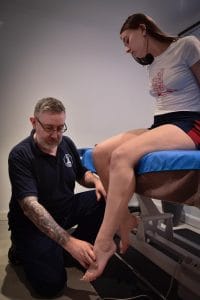
Assessment Comes Before Treatment
One of the important differences at Leading Edge Therapies is that treatment isn’t simply about finding the sore area and massaging it.
Your symptoms, movement, history and physical presentation are considered first. Where appropriate, orthopaedic assessment and testing can help determine whether the problem appears to be related to a muscle, joint, nerve or another musculoskeletal structure.
This helps us decide what type of treatment is appropriate rather than automatically treating every problem as simple muscular tension.
Depending on your presentation, treatment may include orthopaedic massage, manual therapy, joint mobilisation, soft-tissue techniques, exercise advice or other appropriate techniques.
If your assessment suggests that your problem requires medical investigation or treatment outside the scope of the clinic, we’ll tell you that too.
Massage Bathgate for Back, Joint and Muscular Pain
Massage isn’t only about relaxation.
Used appropriately, hands-on treatment can form part of a wider approach to managing musculoskeletal pain and improving movement. The important point is that the treatment should be appropriate for the person and the problem being presented.
For example, someone experiencing back pain in Bathgate may have muscular tension contributing to their symptoms, while another person may have restricted joint movement or symptoms suggesting irritation of another structure.
These situations shouldn’t necessarily be treated in exactly the same way.
This is where assessment becomes important. Rather than assuming that every painful area needs deep pressure or a standard massage, we can use the information gathered during the assessment to guide the treatment.
What About Sports Massage?
You don’t have to be an elite athlete to benefit from a sports massage approach.
Our sports massage service can help people who exercise regularly, participate in recreational sport or simply place repeated physical demands on their bodies.
Sports massage may be appropriate for muscular tension, training-related problems and maintaining movement around physical activity. However, where symptoms are persistent or unusual, an assessment can help determine whether massage is appropriate before treatment begins.
This is particularly useful when someone isn’t sure whether they’re dealing with a straightforward muscular problem or something requiring a different approach.
Pain Doesn't Always Mean You Need to Stop Moving
Persistent pain can understandably make people cautious about exercise and normal activity. However, avoiding movement completely isn’t always the best approach.
The aim of treatment is to understand why the problem is occurring, reduce symptoms where appropriate and help you return to normal movement and activity.
For people who exercise or play sport, this can mean working around the problem while maintaining as much appropriate activity as possible.
Treatment can therefore be about more than simply making an area feel better temporarily. The goal is to help you understand your problem and make informed decisions about returning to the activities that matter to you.
Why Choose Leading Edge Therapies?
At Leading Edge Therapies in Bathgate, we take an assessment-led approach to massage and musculoskeletal problems.
We don’t believe that every person with pain needs the same treatment. By assessing your symptoms before deciding on treatment, we can provide a more individual approach to massage in Bathgate.
Whether you’re dealing with back pain, knee pain, shoulder pain, hip pain, muscular tension, restricted movement or a sports-related problem, our aim is to establish what may be contributing to your symptoms and determine whether hands-on treatment is appropriate.
If you’re unsure whether massage could help your problem, you don’t need to work that out yourself.
Book an assessment at Leading Edge Therapies in Bathgate and let us assess the problem before deciding on the appropriate treatment.