Shoulder Pain
Shoulder pain and now been told it’s Frozen shoulder?
It is a condition in which the glenohumeral (GH) joint loses mobility, in other words becomes frozen, in one or more ranges of motion. There are two stages to frozen shoulder. The first stage involves contraction of the muscles of the GH joint and is called neurogenic frozen shoulder. The second stage involves the formation of fibrous adhesions and is called adhesive capsulitis. Frozen shoulder rarely occurs by itself; rather it usually occurs in response to another condition of the GH joint.
Causes of frozen shoulder:
The GH joint is often described as a muscular joint. This does not mean that it has more musculature than other joints. It means that proportionally, the GH joint depends more on its musculature for stability because its bony shape and ligament/joint capsule complex are designed for mobility, not stability. The glenoid fossa is a shallow socket and its ligament/joint capsule complex is lax, therefore when stability is needed, contraction of the GH musculature is needed to stabilise the joint.
The most common cause of frozen shoulder is the body’s desire to tighten the musculature, usually the rotator cuff musculature (supraspinatus, infraspinatus, teres minor, subscapularis) around the GH joint after an injury such as a rotator cuff tear or trauma. It is common for musculature around an injured joint to tighten in an attempt to splint/stabilize the joint so that it cannot be moved; the premise being that if the joint cannot be moved/used, it will be rested and have a chance to heal. However, in the case of the GH joint, splinting stabilization of its musculature becomes excessive and often ends up immobilizing/freezing the joint. Often, this response is largely or entirely unnecessary because it occurs after the initial injury is mostly or fully healed.
The first “neurogenic” stage is a response to the injury: muscles are directed to tighten; at this point in time there is no structural component to the frozen shoulder, it is merely a functional response by the nervous system to create muscular hypertonicity. However, the longer the neurogenic stage is allowed to exist, the more fascial fibrous collagen adhesions (“fuzz” in the parlance of Gil Hedley) have a chance to form, beginning the structural “adhesive capsulitis” stage. The progression of frozen shoulder condition is often a vicious cycle: the less the joint is moved, the more adhesions form, further decreasing the joint’s ability to move, allowing for more adhesions to form, etc.
Often, the neurogenic stage is effectively jump started by the client. For example, if post injury or post surgery the arm is placed in a sling for an extended period of time, usually a week or more, the neural pattern of immobilization is initiated, and will more likely become patterned into the nervous system than if the client had not immobilized the arm. It also allows for adhesions to begin forming. Therefore immobilization of the shoulder, or simply not moving it through its ranges of motion, increases the chances that frozen shoulder will occur. For this reason, whenever possible, it is important to avoid immobilization of the GH joint.
Signs and Symptoms of frozen shoulder

The most common sign of frozen shoulder is decreased range of motion (ROM).
Of the six cardinal ranges of glenohumeral (GH) motion, the most commonly affected motions are abduction, flexion, and lateral rotation. It is common to compensate for a decreased range of GH motion by increasing shoulder girdle or trunk motion. For example, if arm abduction is decreased, you might increase scapular elevation or even laterally flex the trunk to the opposite side in an attempt to raise the hand higher.
Regarding symptoms, the loss of motion of frozen shoulder often has no accompanying pain. You often simply cannot move your arm fully in one or more ranges of motion. Or, if pain is present, it only occurs if trying to move the arm beyond the point of limitation (tissue tension mechanical barrier). In fact, the lack of pain is often a predisposing factor in the progression of frozen shoulder.
Because the shoulder does not hurt, often people do not feel the need to address the condition until it has progressed to the point that it functionally limits the ability to perform necessary activities of daily life. By this point it time, the condition has often existed for many months and the neural pattern of muscle hypertonicity is more patterned and the degree of fibrous fascial adhesions is great. And if pain with attempted movement is present, it further discourages you from attempting to remedy the condition.
Manual therapy treatment of frozen shoulder
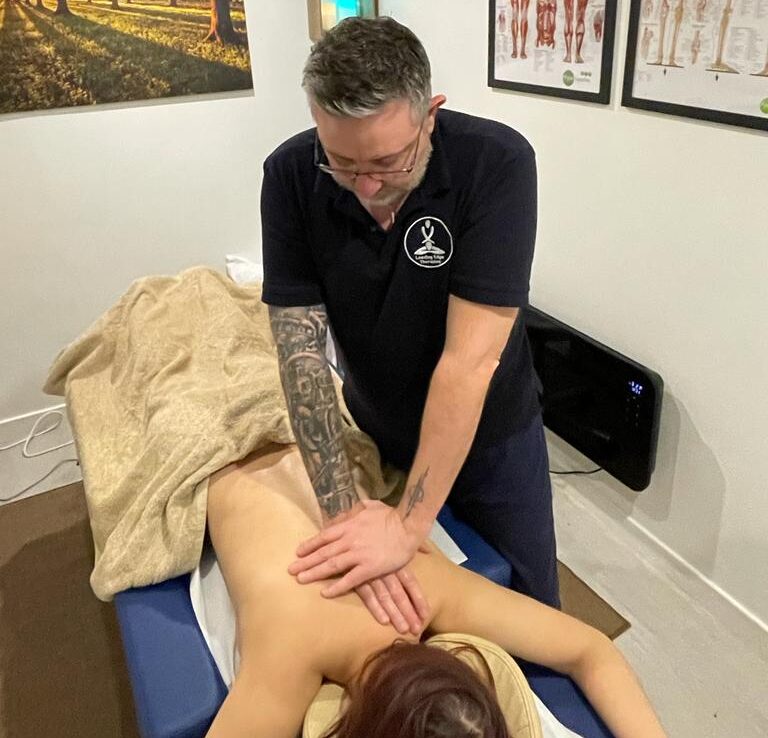
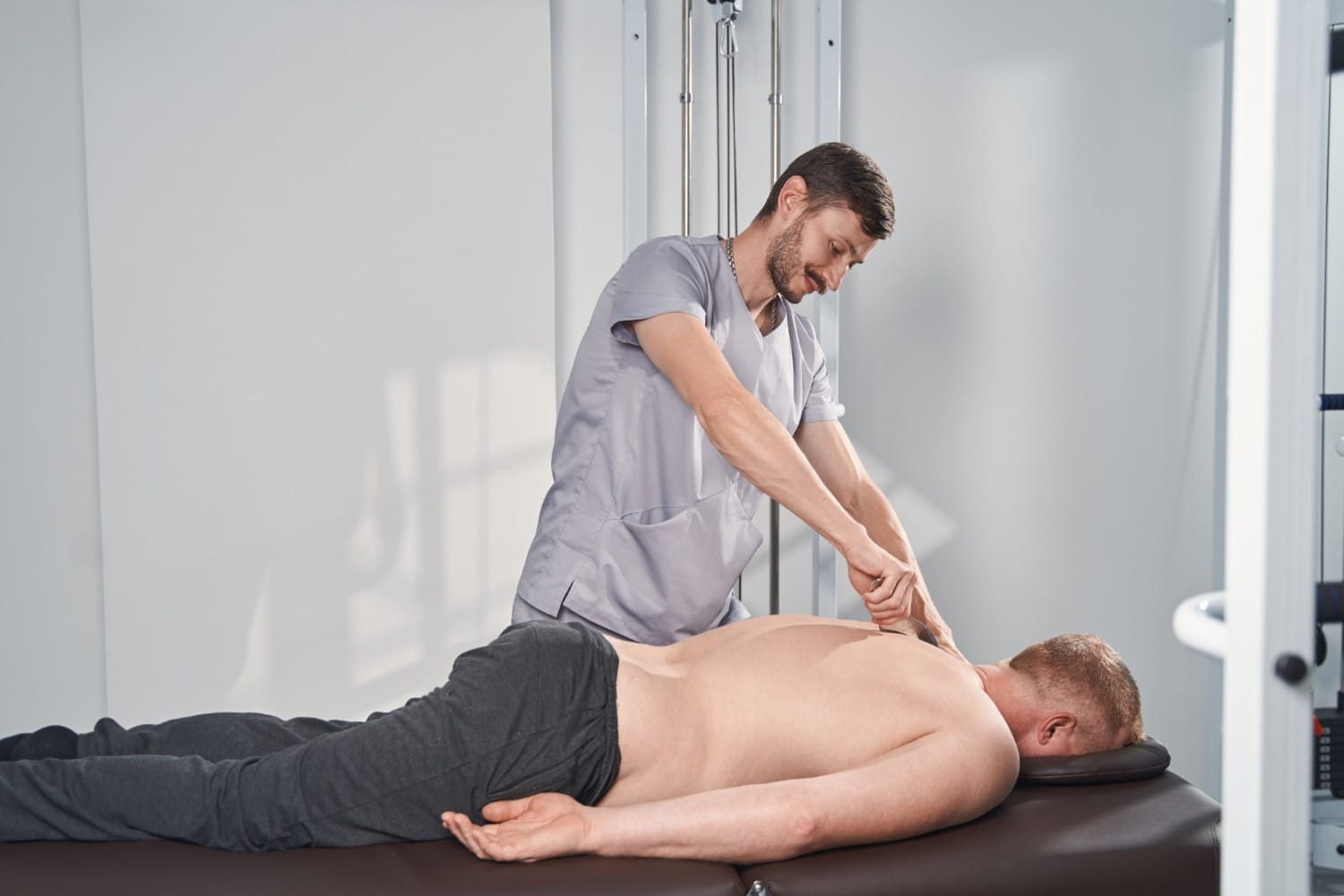
Frozen shoulder often responds extremely well to manual therapy treatment. Depending on how long it has been present, it might require many months of treatment, but it often fully or nearly fully resolves with regular care; the emphasis is on consistent and regular care. Most every neuromuscular condition responds well to the mainstays of clinical orthopedic treatment; they are moist heat (or ice), soft tissue manipulation (massage), stretching, and joint mobilization. With frozen shoulder, moist heat and soft tissue manipulation are important, but should be performed with the aim of increasing the efficiency of the stretching and joint mobilization, which are the two essential treatment modalities.